 |
Courage under fire
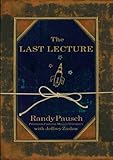
Randy Pausch's "The Last Lecture" was so moving that I ordered 6 more copies. It is a book that I feel everyone should read. Nothing maudalin or sensational in this book, just wonderful insights on how to live your live when faced with the knowledge that your life has an end that is in the immediate future.very pleased
As usual I was very happy with not only the product but the way the order was handled, promptly delivered. I would not hesitate to recommend it to my friends.The Last Lecture
This was a very emotional and moving book. I highly recommend it to all.Simply awesome!
I listened to the audible.com audio book version of this text. I was blown away that anyone could joyfully distill so much practical wisdom in so few words, and sum it all up while facing and fighting pancreatic cancer. I haven't seen the video or read the actual lecture, but now, I'm interested in doing so. Another reviewer admitted to penalizing the book due to the free availability of the lecture video and manuscript. But I'm not likley to have been motivated to partake of either, unless I'd first heard it in audio form. In fact, I'd have more likley read the book. So, even if the additional information contained in the book isn't worth the cost of the book, whether or not the book is valuable also depends upon how individual consumers are attracted to or interested in obtaining content.The Last Lecture - Creating Your Own Virtual Reality
The Last Lecture by Randy Pausch is a book that literally reached out and captured me. It initially caught my eye on the way into a local bookstore with its bright red 40% off discount tag. I had remembered seeing a program on TV about the Last Lecture, the final talk on campus given by a Carnegie Mellon professor who was diagnosed with terminal cancer. I read a few pages and finally decided to buy it. Actually I picked it up and set it down three times before I bought it. Something was calling to me. A day later, I read half of the book before turning out the light to go to sleep, and then decided to finish it the very next morning. The book is made up of little stories and life lessons written by Randy Pausch, the professor from Carnegie Mellon. He shares his deep reflections on the important messages he wants to both give in his last lecture and also leave behind for his wife and three young children, and he share them with a level of sincerity that only a dying person can create. Randy was a software expert in Carnegie Mellon's renowned computer science department. In his book he talks about the positive influence his parents and other people have had on his life, and his own philosophy about life and teaching that he brought to his students. He would use the term `head fake' as way to share the deeper message of his experiences beyond what might be overlooked in a first impression. He describes the obstacles or `brick walls' he encountered during his life as just ways of determining if he really wanted to do something. He believed that hard work and persistence pays off, and that the passion to achieve comes from following your dreams, which often originate in childhood. Randy's computer expertise was in virtual reality. Among many things, he consulted for Disney and his former students now work all over the world in the entertainment industry. Randy and his associates designed courses where students from different disciplines, like the arts, literature and science, could collaborate on developing new computer driven, virtual reality projects. They were allowed to create anything, - talk about the opportunity to let your imagination flow! It proved to be perfect training for the movie industry, which was finding new ways to bridge technology and entertainment. The only condition Randy set was that a project could not involve any form of violence or pornography. He said that they have already been over developed. He was surprised how many young men had a difficult time trying to think of creating anything different, a clear statement about the shortcomings in our current social culture. His courses were challenging and kept his students busy with loads of hard work, learning the programming basics, but for the higher purpose of being able to become great at creating new virtual reality projects. And so when faced with the same inevitable, physical fate that we all must face someday, with either the blessing or tragedy of knowing approximately when his life was to end, Randy, that great teacher of creating virtual realities, devoted his last lecture and book to sharing his advice on how to create your own virtual reality by living life in way that your dreams may come true. Many books have been written with similar themes. Many families are living or have lived with someone having a terminal disease. So what makes Randy Pausch's The Last Lecture so special to me, in addition to the miraculous way he delivered it with courage, humor and heartfelt feeling, is that I feel there is a deeper metaphor about the process of life in Randy's message. It is not a coincidence that a master of virtual reality's most important lecture is about sharing his mastery developed from personal experiences on how to people can better create the reality of their lives. Life is a very special gift, and it also happens to include using the most sophisticated software programming of a virtual reality game imaginable. Each of us has the power to create and live our lives as we so choose. In the religious traditions, this is called free will. This calls to mind other recent books and movies that echo this theme in related ways. Movies like What the Bleep Do We Know and The Secret and their support materials are teaching millions of people about their own ability to program or rather create their own reality. There is a science to it, a very, very sophisticated science, which we are just beginning to understand through mystics and scientists mostly engaged in quantum physics. This is where science and spirituality really start to overlap. Many other writers have carried the same message. Barbara Marx Hubbard has urged people to understand that they no longer have to react to circumstances, but that they have the ability to consciously create the world and move it in a new direction. The Power of Intention by Wayne Dyer is another. The Course in Miracles is also book about how to change a person's life by shifting the person's perspective on his or her reality. Changing one's life is a process of creation. It is an evolutionary process of recreation where we are free to decide who we want to become. All of us are always engage, whether consciously or unconsciously, in the process of becoming through the way we create and experience life. We truly are created in the image and likeness of God the Creator, but not in the physical sense, but in the sense that we have the ability to play the virtual reality game of life to create an infinite combination of experiences as we so choose. And this wonderful process of life all starts with the energy of thought. Thoughts are pure energy that act like magnets that can create and attract events and people to us. In Conversations with God by Neil Walsch, this process of creation is simplified in the three step process of Thoughts, Words and Actions. The virtual reality of the game of life is so real that we can actually taste, touch and smell events beyond what we can see and hear on a computer screen. And this game has artificial intelligence to run our life program whether we are consciously aware of our ability to control the program or not. The difference is that life can be pretty boring or down right miserable when left on auto pilot too long. Collectively we can actually end the game of life if we continue on our path of unconscious creation. The real fun comes in when we first realize that we have the power to take over the controls of our life, our world and reprogram it. This is what Randy and many other writers and spiritual masters have tried to teach us. They teach us how to use our joy stick. As Randy's book reminds us, every act is an act of self definition; a statement as to who we are. It is a statement of our level of consciousness and of our beingness. When we take over the programming of our game of life, master the controls, we become empowered beings, consciously creating our life experiences in ways that lead to more joy and happiness rather than despair, depression and suffering that seems to dominate much of our world today. For joy is the birth right of every human being. I do not know if Randy Pausch realized it when he was living in his body, but I know that he knows now, that the real head fake he gave us all, was that in addition to a very successful career as a computer professor, his real gift to the world was all about conscious creation. The most important message he felt he could give us was not about his technical genius for creating computer driven virtual realities, but it was about how to make our thoughts and dreams become a reality. And all of this first took off from his last lecture. To me, his life serves as a metaphor and a story to teach us how to consciously `program' our lives and show us how our lives can and do interact with all others. This interaction occurs all the time in one very big virtually real game of life, the purpose of which is to bring more happiness and enjoyment into the lives of others by first learning how to create it for ourselves. We can then be an example to others showing them how by how we live our own lives. In Randy's case, it was not just how he lived, but how he died, the impact of which through his Last Lecture will have a positive influence in the world for many years to come.Keyword : textbook


No comments:
Post a Comment